Hainuo HN20 Hollow Glass Microspheres
Coatings-grade filler — high loading, cost-efficient
This grade belongs to the Hainuo Ultra-Light series (true density ≤ 0.30 g/cm³). Made from soda-lime borosilicate glass with an inert-gas-filled sealed cavity, it combines very low density, low thermal conductivity, sound and heat insulation, corrosion resistance and excellent flow — ideal wherever weight and heat transfer are critical.
0.18–0.22Density g/cm³
3.44Strength MPa
500Strength psi
≤70D50 μm
Material code: HGM-20 | Availability: In production | Standard package: 25 kg / bag (paper-plastic composite bag)
Ultra-Light · True density ≤ 0.30 g/cm³
The first choice for maximum light weighting and thermal insulation: the lowest density and lowest thermal conductivity across the range, for buoyancy materials, reflective insulating coatings and lightweight construction — any application where every gram counts.
Selection tip: Confirm the service pressure first: the ultra-light series generally ranges from 2 to 14 MPa and suits atmospheric to medium-low pressure systems. Where higher strength is required, choose an HS-suffixed grade within the same density tier.
Highlights
Product highlights
- Very low true density; significantly reduces system density and raw material consumption
- Sealed hollow cavities form microscopic insulating cells, sharply lowering thermal conductivity
- Spherical shape gives excellent flow and easy dispersion, improving processability
- Low water absorption and chemical stability; long-term stability in service
- Controllable particle size distribution, balancing packing density and surface finish
- Protected by indigenous IP; stable supply and better value than comparable imports
Product description
This grade belongs to the Hainuo Ultra-Light series (true density ≤ 0.30 g/cm³). Made from soda-lime borosilicate glass with an inert-gas-filled sealed cavity, it combines very low density, low thermal conductivity, sound and heat insulation, corrosion resistance and excellent flow — ideal wherever weight and heat transfer are critical.
The ultra-light series is the first choice for solid buoyancy materials, reflective insulating coatings, lightweight concrete and insulating mortars. Confirm the service pressure first: the series generally ranges from 2 to 14 MPa, and HS-suffixed grades offer higher strength at the same density tier.
HN20 in one sentence: Hainuo HN20: true density 0.18–0.22 g/cm³, compressive strength 3.44 MPa(500 psi), D50 ≤70 μm — Coatings-grade filler — high loading, cost-efficient.
Technical data
Physical & mechanical properties
| Property |
Typical value / spec |
Notes |
| True density |
0.18–0.22 g/cm³ |
Density of the solid shell material, excluding inter-particle voids |
| Bulk density |
0.10–0.12 g/cm³ |
Density in loose-packed state; used for packaging and dosing calculations |
| Compressive strength |
3.44 MPa |
Crush rate ≤30% at 3.44 MPa static pressure |
| Compressive strength (imperial) |
500 psi |
Industry-standard unit, widely used in cementing and buoyancy material selection |
| Crush rate |
≤ 30 % |
Upper limit of fractured fraction at the nominal pressure |
| Survival rate |
≥ 70 % |
100% − crush rate; indicates microsphere integrity |
| Float rate |
≥ 98 % |
Fraction that floats in water; indicates the proportion of sealed spheres |
Compressive strength is a nominal value: the crush rate at the stated static pressure does not exceed the value in the table above.
Particle size distribution
| Property |
Typical value / spec |
Notes |
| D10 |
≤ 25 μm |
Particle size at 10% of the cumulative distribution |
| D50 (median) |
≤ 70 μm |
Particle size at 50% of the cumulative distribution; affects packing and surface finish |
| D90 |
≤ 105 μm |
Particle size at 90% of the cumulative distribution |
| Shape |
Thin-walled hollow sphere |
Thin-walled, sealed, high sphericity |
Particle sizes are upper limits (≤); measured reports are supplied with each batch COA.
Material & appearance
| Property |
Typical value / spec |
Notes |
| Composition |
Soda-lime borosilicate glass |
Soda-lime borosilicate glass |
| Appearance |
White, free-flowing hollow spherical powder |
Visual inspection |
| Colour |
White |
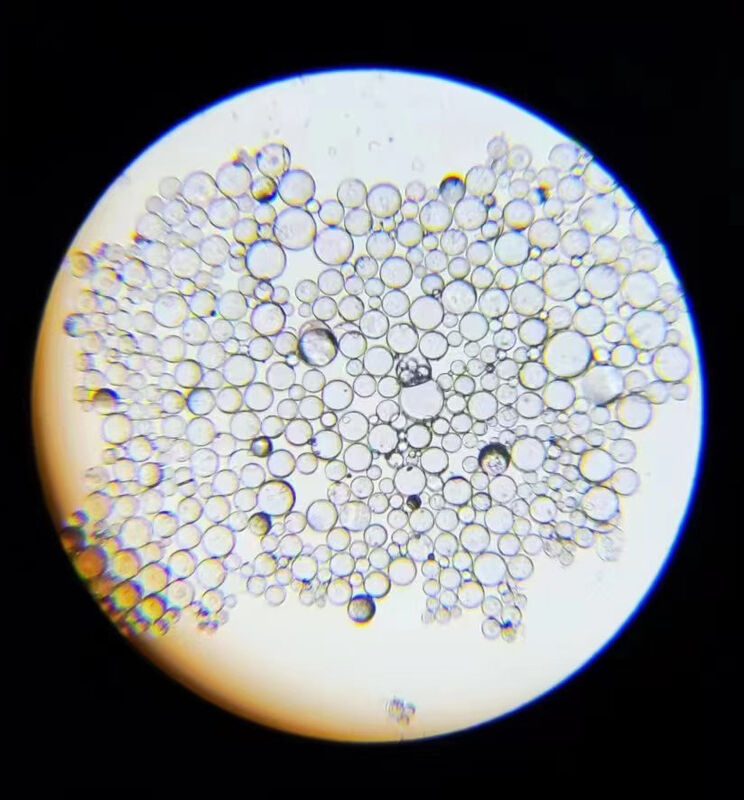
Individual spheres are transparent hollow spheres; bulk form is a white powder |
| pH value |
8.0–9.0 |
Aqueous dispersion |
| Moisture |
≤ 0.3 % |
Factory release control item |
| Dielectric properties |
Measured data on request |
For low-dielectric applications (5G / high frequency) please request data for your frequency band |
Packaging & supply
| Property |
Typical value / spec |
Notes |
| Material code |
HGM-20 |
Reference for orders and contracts |
| Standard package |
25 kg / bag (paper-plastic composite bag) |
Paper-plastic composite bag with moisture barrier liner |
| Optional packaging |
25 kg paper-plastic composite bag (standard) / 10 kg small pack / 500 kg tonne bag / Custom packaging |
Small trial packs and bulk tonne bags both available |
| Availability |
In production |
Standard grades kept in stock |
| Minimum order |
25 kg (1 bag) |
Contact sales for samples and trial packs |
Applications
Typical applications
Adhesives & Sealants4
-
Weld-seam adhesive0.20–0.35 g/cm³
Lowers adhesive density, compensates cure shrinkage, seals and damps vibration
-
Primer adhesive0.20–0.35 g/cm³
Lowers density, resists sagging, improves application and sanding
-
Sealant0.20–0.40 g/cm³
Lowers density, insulates against heat and sound, compensates shrinkage
-
Potting compound0.20–0.40 g/cm³
Lowers density and dielectric constant, buffers stress, protects components
Coatings3
-
Insulating coating0.20–0.40 g/cm³
Sealed hollow spheres create low-conductivity insulating cells
-
Reflective heat-blocking coating0.20–0.40 g/cm³
High solar reflectance, low conductivity, lower surface temperature
-
Repair putty0.20–0.40 g/cm³
Lowers density, easy sanding, resists shrinkage cracking
Composites2
-
Syntactic buoyancy material0.15–0.30 g/cm³
Lowers density and increases buoyancy
-
Engineered stone / sanitaryware0.20–0.40 g/cm³
Lowers density, improves thermal insulation
Other2
-
Emulsion explosive0.15–0.20 g/cm³
Sensitises the matrix, provides hot spots, lowers density
-
Filter media / insulation core0.15–0.40 g/cm³
Creates porosity for filtration and thermal insulation
The application breakdown follows the Hainuo Industry Segmentation (10 Nov 2026). Grades are matched to each application by true-density window; applications marked "high strength" additionally require the strength threshold to be met.
Other typical uses within this series
- Solid buoyancy materials (submersibles, ROV/AUV, USVs)
- Reflective insulating coatings
- Lightweight concrete and boards
- Insulating mortars and putties
- NVH damping and structural foams
- Light weighting for 3D printing
- Civil blasting
Processing & logistics
Processing guidance
- Use low-shear, low-speed dispersion; avoid prolonged high-speed operation of the disperser disc
- Add late: disperse all other components in the base first, then add the microspheres at low speed
- Keep processing temperature below 120 °C
- Store in a dry place; reseal opened bags and use as soon as possible
Packaging
| Standard package |
25 kg / bag (paper-plastic composite bag) |
| Optional packaging |
25 kg paper-plastic composite bag (standard),10 kg small pack,500 kg tonne bag,Custom packaging |
| Package marking |
Grade / batch no. / net weight / production date / shelf life |
Storage & transport
| Storage |
Store in a dry, cool, well-ventilated place; protect from moisture and heavy stacking. Reseal opened bags and use as soon as possible. |
| Shelf life |
24 months in original, unopened packaging under dry storage |
| Transport |
Ship as general cargo; protect from rain, heavy stacking and package damage. Handle with care. |
Safety & handling
Non-toxic, odourless and non-flammable. Wear a dust mask and safety glasses during handling and avoid raising dust.
FAQs
Frequently asked questions
How do I know whether this grade suits my application?
Send us your target density, service pressure (or water depth), processing method and matrix type; our technical team will recommend the matching grade and loading.
Can I get a sample?
Yes. Submit a request through "Request a sample" on this page; standard grades are kept in stock.
How is "compressive strength" defined?
It is the pressure at which the crush rate does not exceed the stated value (for example ≤30%). HN46 is rated 42 MPa (6,000 psi) with a crush rate ≤30%, meaning no more than 30% of the spheres fracture at 42 MPa static pressure.
What is the relationship between crush rate and survival rate?
Survival rate = 100% − crush rate. The published crush rate is an upper limit; the value actually observed after processing is also affected by shear, temperature and the matrix.
What does float rate mean?
Float rate is the proportion of spheres that float in water. It reflects sphere integrity and sealing: a higher float rate means fewer broken or open spheres, and therefore more stable buoyancy and insulation.
What are the minimum order quantity and lead time?
Standard grades are kept in stock with a minimum order of 25 kg (1 bag). Please contact sales for bulk lead times and custom grade development.
Can you customise a grade to a specific density or strength?
Yes. Send us your target true density, compressive strength and particle size distribution; our technical team will assess feasibility and arrange trial validation.


 Your message must be between 20-3,000 characters!