logo
Home > products > Hollow Glass Microspheres >
Ultra-Fine High-Strength Low-Density Hollow Glass Microspheres for Adhesives Sealants Coatings Composites Rubber and Plastics

Ultra-Fine High-Strength Low-Density Hollow Glass Microspheres for Adhesives Sealants Coatings Composites Rubber and Plastics

Ultra-Fine Hollow Glass Microspheres

High-Strength Glass Microspheres

Low-Density Hollow Glass Microspheres

Place of Origin:

China

Brand Name:

Hainuo

Model Number:

HN32HS Hollow Glass Microspheres

Contact Us

Request A Quote
Product Details
Payment & Shipping Terms
Minimum Order Quantity
25 kg (1 bag)
Packaging Details
25 kg / bag (paper-plastic composite bag);Optional packaging:25 kg paper-plastic composite bag (standard) / 10 kg small pack / 500 kg tonne bag / Custom packaging
Supply Ability
In production
Product Description
Ultra-fine high-strength low-density grade

This grade belongs to the Hainuo Low-Density series (true density 0.30–0.50 g/cm³). Produced from soda-lime borosilicate glass, it consists of micron-scale hollow spheres offering light weight with high strength, thermal insulation, chemical resistance and a low dielectric constant — a key functional filler in the advanced composites value chain.

0.30–0.34Density g/cm³
28Strength MPa
4,000Strength psi
≤20D50 µm

NO1 Highlights

Product highlights
  • Best balance of density, strength and particle size — the widest application coverage
  • Markedly reduces system density and consumption of resin and other raw materials
  • Spherical shape distributes stress; improves impact resistance and reduces cracking and shrinkage
  • Low thermal conductivity and low dielectric constant, serving both insulation and electrical needs
  • Free-flowing and easy to disperse on conventional plastics and coatings equipment
  • Stable domestic supply; a drop-in alternative to comparable imported grades
Product description

This grade belongs to the Hainuo Low-Density series (true density 0.30–0.50 g/cm³). Produced from soda-lime borosilicate glass, it consists of micron-scale hollow spheres offering light weight with high strength, thermal insulation, chemical resistance and a low dielectric constant — a key functional filler in the advanced composites value chain.

The low-density series covers automotive SMC/BMC, electronic potting, 5G low-dielectric materials, oil-well cementing and drilling, and industrial insulating and anti-corrosion coatings. Within a density tier, HS = high strength, HL = economy light weighting, and -1/-2 = sub-grades.

HN32HS in one sentence: Hainuo HN32HS: true density 0.30–0.34 g/cm³, compressive strength 28 MPa(4,000 psi), D50 ≤20 µm — Ultra-fine high-strength low-density grade.

NO2 Technical data


Physical & mechanical properties
Property Typical value / spec Notes
True density 0.30–0.34 g/cm³ Density of the solid shell material, excluding inter-particle voids
Bulk density 0.15–0.18 g/cm³ Density in loose-packed state; used for packaging and dosing calculations
Compressive strength 28 MPa Crush rate ≤35% at 28 MPa static pressure
Compressive strength (imperial) 4,000 psi Industry-standard unit, widely used in cementing and buoyancy material selection
Crush rate ≤ 35 % Upper limit of fractured fraction at the nominal pressure
Survival rate ≥ 65 % 100% − crush rate; indicates microsphere integrity
Float rate ≥ 95 % Fraction that floats in water; indicates the proportion of sealed spheres
Compressive strength is a nominal value: the crush rate at the stated static pressure does not exceed the value in the table above.
Particle size distribution
Property Typical value / spec Notes
D10 ≤ 10 µm Particle size at 10% of the cumulative distribution
D50 (median) ≤ 20 µm Particle size at 50% of the cumulative distribution; affects packing and surface finish
D90 ≤ 40 µm Particle size at 90% of the cumulative distribution
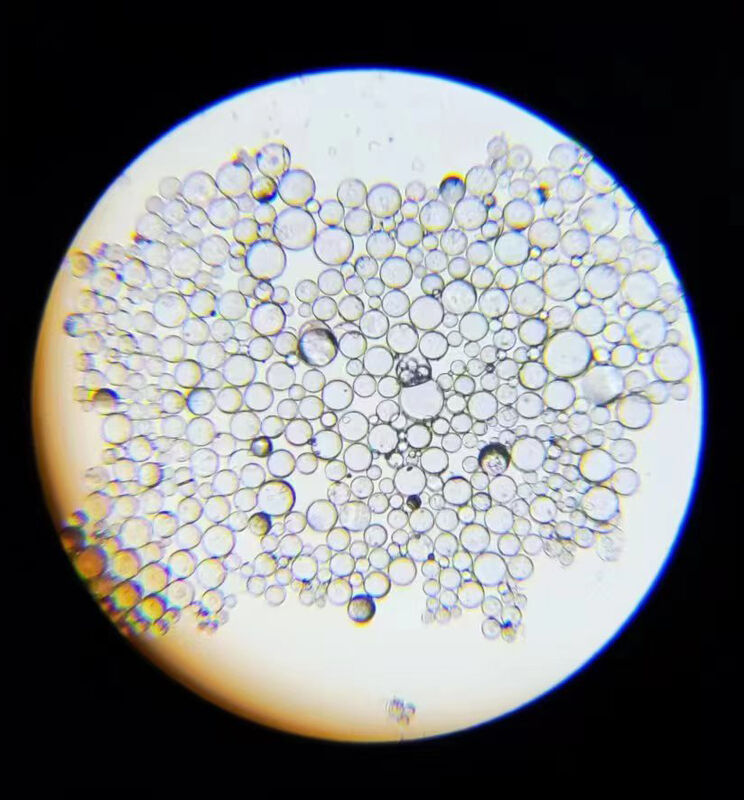
Shape Thin-walled hollow sphere Thin-walled, sealed, high sphericity
Particle sizes are upper limits (≤); measured reports are supplied with each batch COA.
Material & appearance
Property Typical value / spec Notes
Composition Soda-lime borosilicate glass Soda-lime borosilicate glass
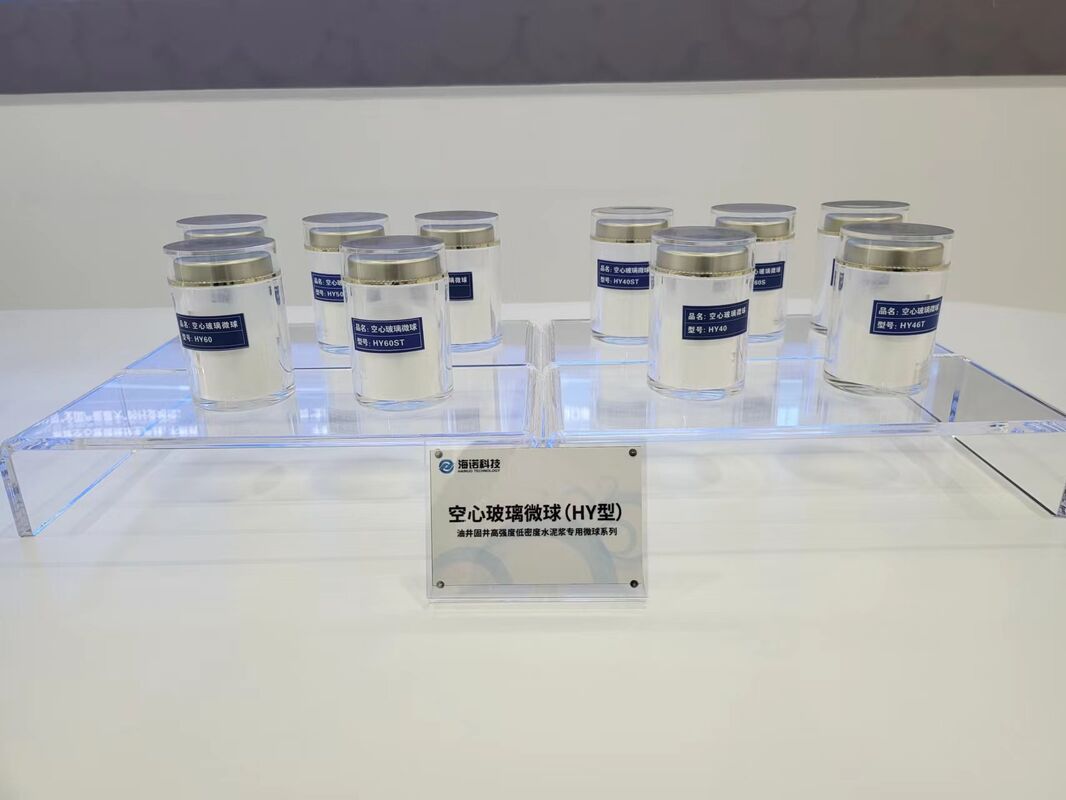
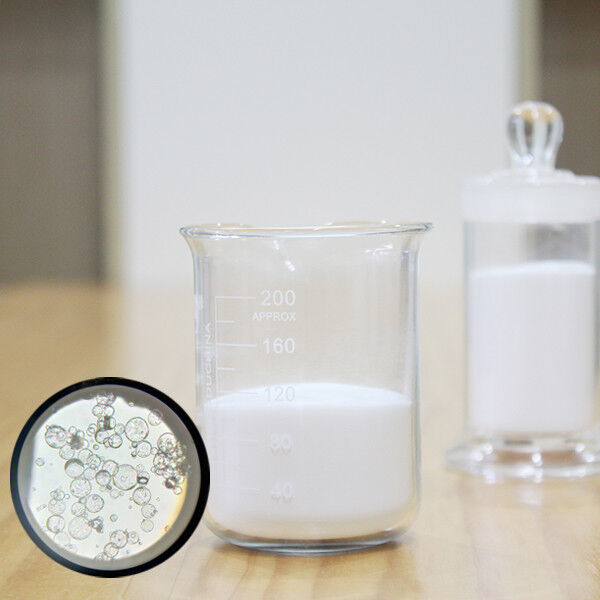
Appearance White, free-flowing hollow spherical powder Visual inspection
Colour White Individual spheres are transparent hollow spheres; bulk form is a white powder
pH value 8.0–9.0 Aqueous dispersion
Moisture ≤ 0.3 % Factory release control item
Dielectric properties Measured data on request For low-dielectric applications (5G / high frequency) please request data for your frequency band
Packaging & supply
Property Typical value / spec Notes
Material code HGM-32HS Reference for orders and contracts
Standard package 25 kg / bag (paper-plastic composite bag) Paper-plastic composite bag with moisture barrier liner
Optional packaging 25 kg paper-plastic composite bag (standard) / 10 kg small pack / 500 kg tonne bag / Custom packaging Small trial packs and bulk tonne bags both available
Availability In production Standard grades kept in stock
Minimum order 25 kg (1 bag) Contact sales for samples and trial packs

NO3 Applications


Typical applications

Adhesives & Sealants4

  • Weld-seam adhesive0.20–0.35 g/cm³

    Lowers adhesive density, compensates cure shrinkage, seals and damps vibration

    Body seam sealing and spot-weld adhesives | Automotive OEM
  • Primer adhesive0.20–0.35 g/cm³

    Lowers density, resists sagging, improves application and sanding

    Automotive and construction primers | Automotive / Construction
  • Sealant0.20–0.40 g/cm³

    Lowers density, insulates against heat and sound, compensates shrinkage

    PU, silicone and polysulphide sealants | Construction / Automotive
  • Potting compound0.20–0.40 g/cm³

    Lowers density and dielectric constant, buffers stress, protects components

    Potting of electronic components and power supplies, EMC encapsulation | Electrical & electronics

Coatings4

  • Insulating coating0.20–0.40 g/cm³

    Sealed hollow spheres create low-conductivity insulating cells

    Exterior walls and roofs, equipment insulation | Advanced building materials
  • Reflective heat-blocking coating0.20–0.40 g/cm³

    High solar reflectance, low conductivity, lower surface temperature

    Tanks, pipes, roofs and grain silos | Advanced building materials
  • Heavy-duty anti-corrosion coating0.30–0.45 g/cm³

    Lowers density, resists sagging in thick films, adds insulation

    Marine, offshore and steel structures | Industrial anti-corrosion
  • Repair putty0.20–0.40 g/cm³

    Lowers density, easy sanding, resists shrinkage cracking

    Automotive, panel-beating and FRP repair | Automotive aftermarket

Composites3

  • Syntactic buoyancy material0.15–0.30 g/cm³

    Lowers density and increases buoyancy

    Deep-sea buoyancy blocks and syntactic foam | Offshore engineering / Deep-sea equipment
  • Engineered stone / sanitaryware0.20–0.40 g/cm³

    Lowers density, improves thermal insulation

    Engineered stone and sanitaryware | Home & building materials
  • FRP (glass-reinforced plastic)0.30–0.50 g/cm³

    Lowers density, light and strong, insulating

    Hand lay-up, vacuum infusion and pultruded FRP | Composites

Rubber & Elastomers2

  • Footwear sole0.30–0.50 g/cm³

    Lowers density, reduces weight, improves rebound cushioning

    EVA / PU / rubber foam light weighting | Sports & leisure
  • TPE pillow / memory foam0.30–0.40 g/cm³

    Lowers density, reduces weight, slow rebound

    Weight reduction and rebound tuning | Household

Plastics1

  • 3D printing material0.20–0.50 g/cm³

    Lowers density, light weighting

    Lightweight filaments and powders | Additive manufacturing

Other1

  • Filter media / insulation core0.15–0.40 g/cm³

    Creates porosity for filtration and thermal insulation

    Pore formation, filtration, insulation | Environmental / Building materials
The application breakdown follows the Hainuo Industry Segmentation (10 Nov 2026). Grades are matched to each application by true-density window; applications marked "high strength" additionally require the strength threshold to be met.
Other typical uses within this series
  • Automotive SMC / BMC / RIM composites
  • PP / PA / PBT injection-moulded parts
  • Low-dielectric 5G fillers (base stations, radomes, mmWave)
  • Electronic potting compounds and copper-clad laminates
  • Oil-well cementing and drilling fluids
  • Industrial insulating and anti-corrosion coatings
  • Appliance insulating plastics
  • Rubber seals and footwear

NO4 Processing & logistics


Processing guidance
  • Use low-shear, low-speed dispersion; keep disperser tip speed at or below 8 m/s
  • Add late: add the microspheres last, at low speed
  • Keep processing temperature below 120 °C; the glass softening point is approx. 620 °C
  • Use the full bag once opened, or reseal and store in a dry place
Packaging
Standard package 25 kg / bag (paper-plastic composite bag)
Optional packaging 25 kg paper-plastic composite bag (standard),10 kg small pack,500 kg tonne bag,Custom packaging
Package marking Grade / batch no. / net weight / production date / shelf life
Storage & transport
Storage Store in a dry, cool, well-ventilated place; protect from moisture and heavy stacking. Reseal opened bags and use as soon as possible.
Shelf life 24 months in original, unopened packaging under dry storage
Transport Ship as general cargo; protect from rain, heavy stacking and package damage. Handle with care.
Safety & handling
Non-toxic, odourless and non-flammable. Wear a dust mask and safety glasses during handling and avoid raising dust.

NO5 FAQs


Frequently asked questions
What do the HS / HL / -1 / -2 suffixes mean?
HS = high-strength variant within the same density tier; HL = economy lightweight variant (wider crush-rate tolerance, better cost); -1/-2 = sub-grades of the same family, differing mainly in crush rate and particle size distribution.
How do I determine the loading?
It depends on the target density and performance required. Typical levels are 5%–20% for coatings and adhesives, 10%–30% for composites and 10%–40% for cement dry blends. Always validate with a lab trial first.
How is "compressive strength" defined?
It is the pressure at which the crush rate does not exceed the stated value (for example ≤30%). HN46 is rated 42 MPa (6,000 psi) with a crush rate ≤30%, meaning no more than 30% of the spheres fracture at 42 MPa static pressure.
What is the relationship between crush rate and survival rate?
Survival rate = 100% − crush rate. The published crush rate is an upper limit; the value actually observed after processing is also affected by shear, temperature and the matrix.
What does float rate mean?
Float rate is the proportion of spheres that float in water. It reflects sphere integrity and sealing: a higher float rate means fewer broken or open spheres, and therefore more stable buoyancy and insulation.
What are the minimum order quantity and lead time?
Standard grades are kept in stock with a minimum order of 25 kg (1 bag). Please contact sales for bulk lead times and custom grade development.
Can you customise a grade to a specific density or strength?
Yes. Send us your target true density, compressive strength and particle size distribution; our technical team will assess feasibility and arrange trial validation.

Send your inquiry directly to us

Privacy Policy China Good Quality Hollow Glass Microspheres Supplier. Copyright © 2023-2026 hollow-microspheres.com . All Rights Reserved.